

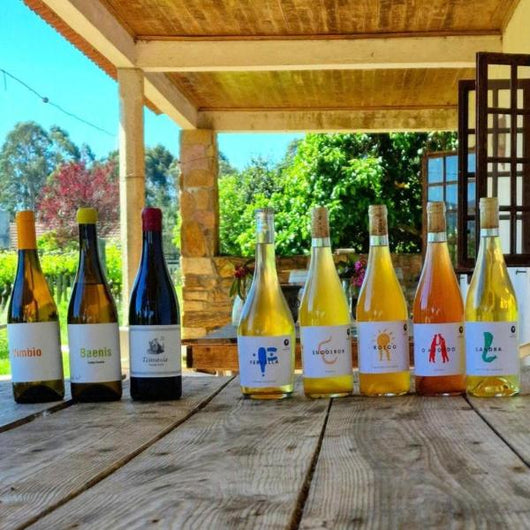
Adega do Vimbio
Adega do Vimbio is a Galician winery located in Goián, Tomiño, in the province of Pontevedra, very close to the final stretch of the Miño River and the border with Portugal. Its history began in 1985, when Martín Crusat's family acquired the estate and planted the first vines. Today, the project has 2.5 hectares spread over three plots: Casendo, Veque, and O Gaiteiro.
At the helm of the winery are Martín Crusat, a biologist, and Patricia Elola, who holds a degree in Environmental Sciences. After a decade working abroad, in 2012 they returned to Galicia to develop their own project, based on sustainability, artisanal work, and minimal intervention in the winery.
Their winemaking approach seeks to fully respect the identity of each vineyard. They work with spontaneous fermentations using indigenous yeasts and avoid unnecessary corrections, with the aim of creating fresh, honest, and characterful wines.
Their vines grow on schist, clay, and fluvial pebble soils, providing freshness, tension, and a marked mineral expression. In 2020, Martín and Patricia decided to work outside the D.O.P. Rías Baixas to have greater winemaking freedom and to be able to produce more personal wines, without necessarily conforming to the criteria of a specific denomination.
Among their wines, Vimbio stands out, a name that refers to the Galician term for wicker, traditionally used to tie vines. They also produce unique references such as Roico, Encoiros, and O Acordo, small-production wines that show a free, artisanal vision closely linked to the Galician landscape.
At VinNatura, we selected Adega do Vimbio for its authenticity, its respect for the environment, and its honest approach to understanding wine. These are Galician wines with character, designed for those seeking different, fresh, and gastronomic productions.
Transparency Note
The Adega do Vimbio wines we currently present are not covered by a specific D.O.P. or I.G.P. They are described as small-production Galician wines, made with an artisanal approach and minimal intervention, without attributing a protected designation when it is not applicable.


